Wix, Squarespace, and GoDaddy: The Real SEO Cost of Building Your Own Website
by James Brace, Owner and Operator
Website builder SEO problems with Wix, Squarespace, and GoDaddy don't announce themselves. They tend to show up quietly — weeks or months after launch — when a business owner starts wondering why the phone still isn't ringing.
A plumber in Lansdale spent a Saturday building his new website on Wix. He picked a clean template, uploaded some photos, wrote out his services, and hit publish. He even figured out how to add his address. He told his wife it looked professional. He wasn't wrong — it did look professional. Two months later, he still wasn't showing up in Google searches for "plumber Lansdale."
This isn't a Wix horror story. The platform worked exactly as advertised. He built a website. It was live. But looking professional and ranking in search are two very different things, and most website builders are optimized to help you with one of them.
I've seen this pattern enough times to recognize it: a business owner invests real time — sometimes a full weekend — into a builder like Wix, Squarespace, or GoDaddy. The result looks decent. But somewhere under the surface, the website builder SEO problems are quietly creating a ceiling on what that site can ever achieve in search. Here's what those limitations are, where they come from, and what you can actually do about them.
What Website Builders Actually Get Right
Before anything else: Wix, Squarespace, and GoDaddy are genuinely good at what they're designed for. If you need to go from zero to live in a weekend without knowing how to code, these platforms deliver. The templates look modern, the interfaces are intuitive, and you don't need to understand hosting, servers, or deployment. For a brand-new business that needs something on the web fast, that accessibility has real value.
Squarespace has strong design sensibility. Wix has expanded its SEO features meaningfully in recent years — they now support meta descriptions, structured URLs, and basic schema through their App Market. GoDaddy's builder is quick to set up and works fine as a digital business card.
The limitations aren't about these platforms being poorly made. They're structural — the natural result of building a product that has to work for millions of different businesses without any of them needing to touch a line of code. When you're building for everyone, you can't fully optimize for anyone.
The Website Builder SEO Problems Start With Performance
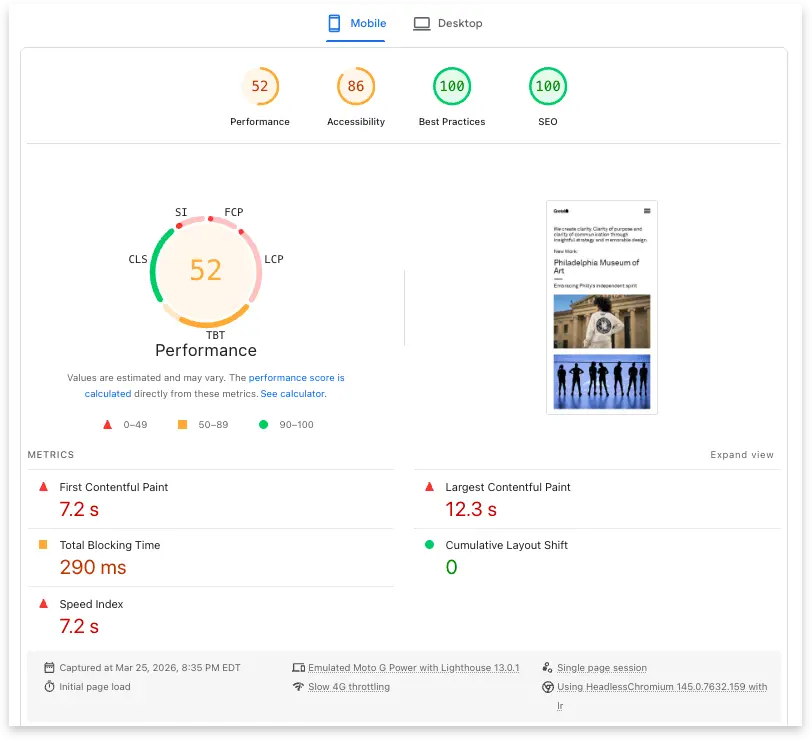
PageSpeed Insights of a Squarespace site
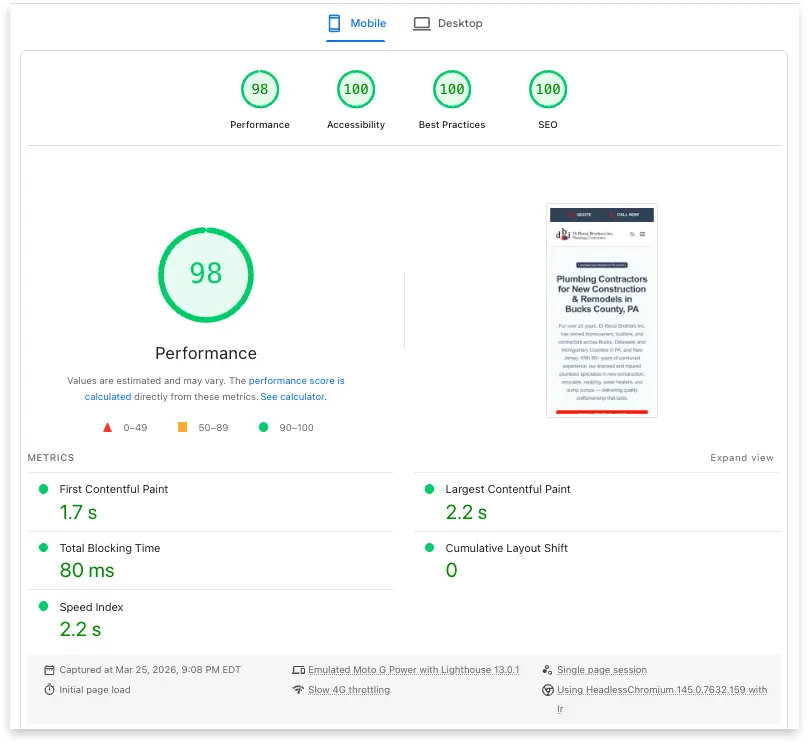
PageSpeed Insights of a OneUp Digital site
Why Website Builders Are Slower
Here's where the gap between builders and custom sites shows up most clearly in the data. According to an HTTPArchive Core Web Vitals Technology Report from April 2024, only about 52% of Wix sites pass Google's Core Web Vitals — and Squarespace comes in at around 58%. That means roughly half of all Wix sites, and more than 40% of Squarespace sites, are failing the performance benchmarks Google uses to assess user experience.
Website builders ship with JavaScript that powers every feature the platform offers — even features your site doesn't use. That extra code adds up. On a custom-built site, you only load what the page actually needs.
How Core Web Vitals Affect Local SEO Rankings
Core Web Vitals are Google's way of measuring how a real person experiences your page: how fast the main content loads, how quickly the page responds to a tap or a click, and whether the layout shifts around unexpectedly while loading. When your site fails these benchmarks, it doesn't drop off the first page overnight. But when two similar businesses are competing for the same search result and one passes and one doesn't, Google's system tends to break that tie in favor of the faster site.
This matters more for small businesses than for large ones. A national brand with thousands of backlinks can absorb a speed penalty. A plumber competing against five other local plumbers cannot.
The speed-to-conversion relationship makes this concrete: research from Portent found that sites loading in one second convert at around 39%, while sites taking six seconds convert at just 18%. That's not about massive e-commerce retailers — that applies to any page a potential customer lands on. Slow sites don't just rank lower; the people who do find them are less likely to call.
With a custom-built site, performance is something you design in from the start — optimized images, lean code, no unnecessary scripts loading in the background. On a builder, you inherit whatever the platform ships by default, including JavaScript powering features you may never use.
Why Wix and Squarespace Lack Custom Schema Markup
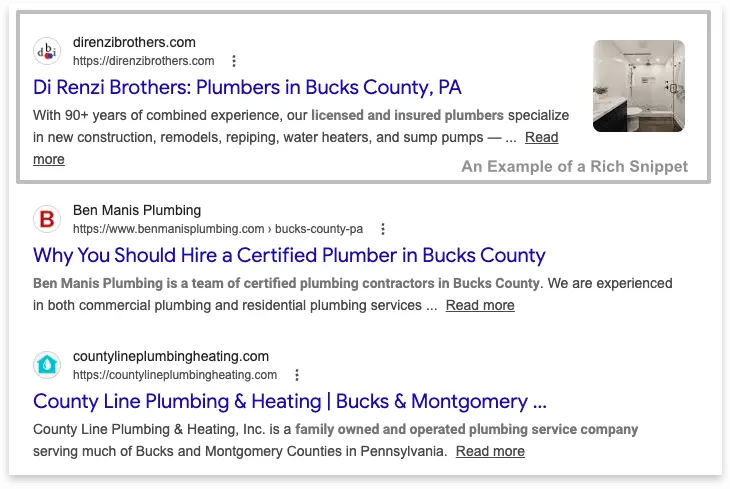
Google search results page showing rich snippets
There's a feature called schema markup that most small business owners have never heard of, and that's exactly the problem. Schema is structured data you add to a website to tell Google explicitly what your business is, what services you offer, what your hours are, and what your customers think of you. When Google understands your site clearly, it can reward you with enhanced search results: star ratings, FAQ panels, service categories, images, and other features that make your listing stand out before anyone clicks.
Research from WeAreTG has found that websites with schema markup see 20–30% higher click-through rates from search results. That means more people who see your listing actually click it — without you spending a dollar more on ads.
Wix offers some basic schema support, primarily for business address and contact details. But service-based businesses benefit most from custom schema — a plumber with FAQ markup, a contractor with review markup, a restaurant with menu schema. On builder platforms, adding the right schema for a specific business type, or combining multiple schema types, typically requires a paid app or workarounds that don't always validate correctly with Google.
This gap matters more than it used to. In 2025, roughly 60% of Google searches ended without a user clicking any result — Google is increasingly answering questions directly on the search page, pulling from sites it trusts enough to feature. Schema markup is one of the signals that builds that trust and gets you into those featured positions.
Vendor Lock-In: The Long-Term Risk Nobody Mentions at Signup
When you build on Wix, Squarespace, or GoDaddy, your content, your design, your URL structure, and your SEO history are all tied to that platform's infrastructure. If the platform raises prices significantly, discontinues a feature you depend on, or you simply outgrow what it can do, migrating somewhere else is genuinely complicated.
The SEO risk is specific: your URLs may not transfer cleanly to a new platform. If the structure changes, inbound links pointing to your old pages can break. Domain authority and ranking equity you've built up over time is at risk during any transition. This is vendor lock-in, and it's an underappreciated risk for businesses building on these platforms — one that's easy to overlook when you're just trying to get online quickly.
None of this means you'll definitely face this problem. But it's worth knowing it exists before you spend two years building content on a platform you may eventually want to leave.
A custom-built site — whether in React, another modern framework, or well-structured WordPress — belongs to you architecturally. Your URLs, your structure, and your content travel with you if you ever move to different hosting. There's no platform-specific format to escape.
One Thing You Can Do Right Now
If you're already on a website builder and not ready to change anything, this is worth doing today: run your site through Google's PageSpeed Insights. It's free, takes about thirty seconds, and shows you exactly where your site stands on Core Web Vitals. It won't fix anything automatically, but it will tell you whether you have a performance problem worth addressing — and it often surfaces quick wins like image compression recommendations you can act on immediately without touching any code.
If your scores are in the green, you're in better shape than many. If they're in the red, you have a specific, concrete problem that's worth understanding.
The Ceiling Problem
Website builders have made it genuinely possible for anyone to put a professional-looking site on the internet without a developer. That's real, and it's helped a lot of small businesses get started. The issue isn't that these platforms are bad — it's that they have structural limits, and those limits tend to become most visible exactly when your business is growing and you need your website to work harder.
A builder with weak SEO infrastructure creates a ceiling no amount of content can break through. You can write great blog posts, update your services page, collect every review from every happy customer — and still find yourself stuck below competitors whose sites are simply built better under the hood.
We saw the opposite of this with Di Renzi Brothers Plumbing. After launching a custom-built site paired with Google Business Profile optimization, they saw roughly 67% traffic growth in about two months. The design mattered, but so did the performance, the clean architecture, and the fact that the site was built with search in mind from the first line of code. You can read the full case study here.
Understanding where the website builder SEO problems are — and whether you're hitting that ceiling — is the first smart step. If you'd like an honest look at where your site stands, we offer a free website audit: a clear picture of what's working and what might be holding you back. No pitch at the end, no strings attached.
Frequently Asked Questions
Does Wix hurt SEO for small businesses? Wix doesn't actively hurt SEO, but it has structural limits that can cap your search performance over time. Core Web Vitals pass rates, limited schema markup options, and vendor lock-in are real constraints — especially for service-based businesses competing in local search. Many Wix sites rank for some terms, but the platform's architecture makes it harder to hit the technical benchmarks that give you an edge in competitive markets. Can you rank on page one with Squarespace? Yes, you can — and some Squarespace sites do rank well. The platform has improved its SEO tooling meaningfully in recent years. Where it tends to fall short is Core Web Vitals performance (only about 58% of Squarespace sites pass, according to HTTPArchive data from April 2024) and custom schema markup, which limits your chances of appearing in enhanced search features like FAQ panels and star ratings. Why is my GoDaddy website not showing up on Google? There are a few common reasons: the site may not be indexed yet, the pages may lack optimized meta titles and descriptions, your Google Business Profile may not be set up or verified, or the site may have performance issues affecting its ability to compete in search. Running your site through Google's free
PageSpeed Insights
tool and verifying it in Google Search Console are good first diagnostic steps.