- From Invisible to Found: A Plumbing Website That Actually Generates Leads (6-Month Update)
Six months in, Di Renzi Brothers Plumbing went from no online presence to showing up for 200+ local plumbing searches and getting real leads from PA homeowners. Here is the data — and what we built.
- Client
- Di Renzi Brothers Inc.
- Year
- Service
- Website Strategy, Web Design, Development, Local SEO, Google Business Profile Setup, CMS Implementation
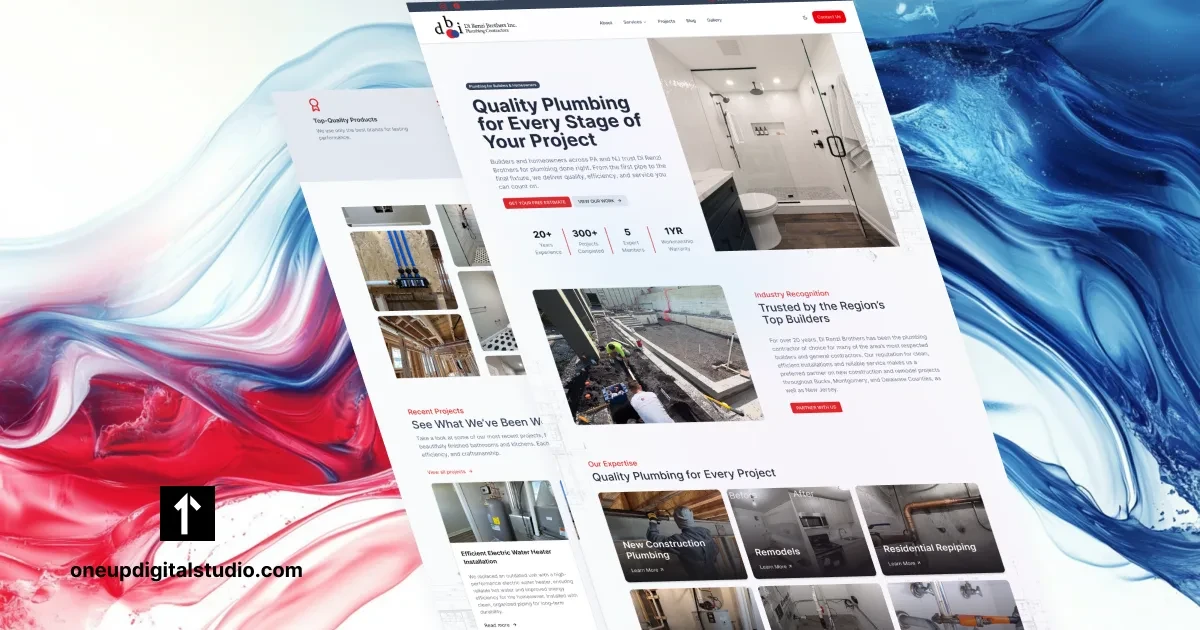
A real plumbing company. A real website. Real leads — with the data to prove it.
If you run a local service business, you've probably wondered if a real website is worth the money. This case study is for you.
It tells the full story of one project. We started with a plumber who had no online presence at all. Six months later, the site shows up for hundreds of local searches and brings in real form submissions, phone clicks, and quote requests every month. We'll walk you through the process, the price range, the real data, and what to expect if you want to do the same for your business.
No fake numbers. No "10x your leads overnight." Just what happened, what it cost, and what it took.
The Starting Point: A Strong Business With No Front Door
Di Renzi Brothers Plumbing serves Bucks, Montgomery, and Delaware counties in Pennsylvania, plus parts of New Jersey. They built the business the old-fashioned way — referrals, builder relationships, and remodel work. Their entire online presence was:
- A Facebook page
- An Instagram account
- An unverified Google Business Profile
If a homeowner Googled "plumber Bucks County" or "water heater replacement Bensalem," Di Renzi Brothers didn't show up. There was no website to find, no verified Google profile in Maps, and no easy way for a new customer to check that the business was real before calling.
Thousands of skilled local service businesses are in the exact same spot right now.
Our Framework: How We Build Websites That Actually Get Found
Before any design work, we run every project through the same four-phase framework. We're sharing it here not to give away every trick, but to show there's a real, repeatable process behind the result.
Phase 1 — Discover
A simple questionnaire to learn:
- The core services and specialties
- Service areas and target customers
- What makes the company different
- Existing brand assets, photos, and reputation
This is the boring work that decides whether the website ranks or just sits there. Most agencies skip it.
Phase 2 — Plan
A demo site that maps every page, every button, and every link before anyone touches design. This is where we agree on the structure that decides what Google sees and what customers click.
Phase 3 — Build
Service pages first. Always. Each one is written the way real customers in real towns search — not generic "Plumbing Services" copy. The homepage and design polish come last, after the SEO foundation is in place.
We also set up a content management system (Sanity) so the team can update content on their own. No retainer needed. No waiting on a developer to change a phone number.
Phase 4 — Launch
Before going live on October 27, 2025, the site went through a full pre-launch checklist: domain setup, analytics, page titles and descriptions, page speed, mobile testing, internal links, and a full Google Business Profile rebuild with services and branded photos.
That last piece — the Google Business Profile work — is often more important than the website itself for showing up in local search. Most contractor sites get it wrong.
The First 60 Days: Day-One Momentum
The site went live October 27, 2025. We tracked two 30-day windows right after launch to make sure the foundation was working before pushing into the next phase:
- Period 1 (Oct 27 – Nov 23)
- 42 unique sessions
- Period 2 (Nov 23 – Dec 23)
- 70 unique sessions
- Month-over-month growth
- +67%
Two months in, three things were clear: visitors weren't bouncing off the homepage, they were spending real time on service pages, and the site had started showing up in Google for local plumbing searches. That's when the project went from "launched" to "earning its keep."
The numbers in the next section are what happened over the four months that followed.
Six Months Later: Here's What the Data Actually Shows
This is where most case studies get fuzzy. Ours doesn't.
Below is the raw data from Google Search Console and Umami analytics for January 1 – April 30, 2026 — the four months after the launch period above, once the site had time to settle in and start ranking.
1. Search visibility AND clicks both grew month over month
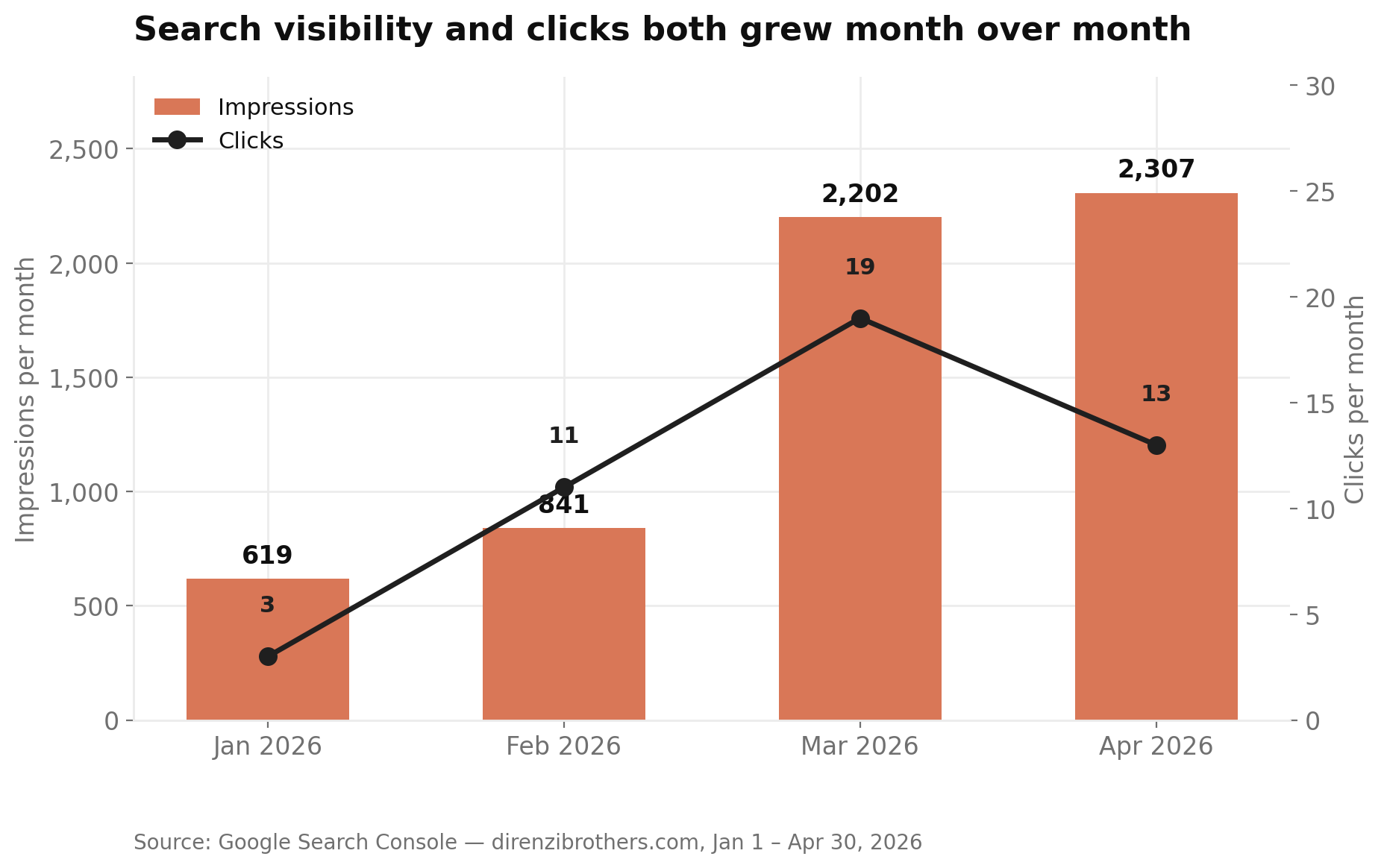
Two numbers moving together is the signal that matters:
- Impressions: 619 → 2,307 per month (a 273% jump in visibility)
- Clicks: 3 → 19 per month, with 46 total Google clicks across the window
- Site CTR (click-through rate): 0.77% — and yes, that's low on its own. But CTR is a vanity number at this stage; the click-rate work comes next, once we know which pages are actually showing up. The number that pays the bills is further down: 8.3% of visitors who land on a service page convert into a lead. That's the metric that hits the client's bank account, and it's already healthy.
This isn't paid traffic. It's the site organically showing up — and getting clicked — when homeowners in PA, NJ, and DE search for the kind of work Di Renzi does.
2. Now showing up for searches with real buying intent
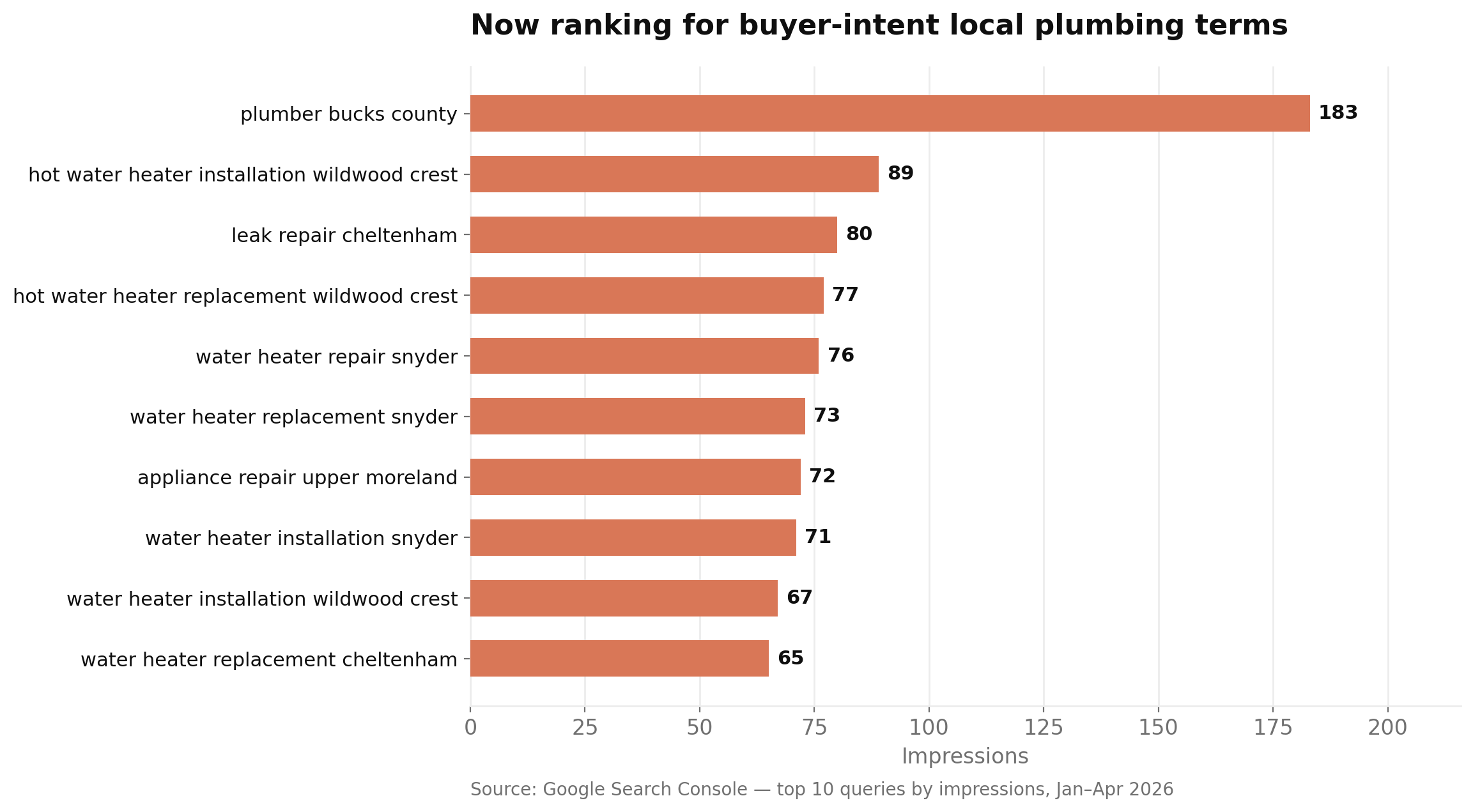
Across four months, the site appeared in Google for hundreds of different local plumbing searches — things like:
plumber bucks county(183 impressions)hot water heater installation wildwood crestleak repair cheltenhamsump pump installation philadelphiarepiping bensalem pa
These aren't vanity terms. Each one is a homeowner with a problem, looking for someone to call.
There's a second signal that matters: branded search has started. People are now Googling "direnzi brothers inc," "renzi brothers," and "direnzi" by name. That signal didn't exist six months ago. The brand is being remembered, and the website is the asset that catches that interest.
And here's the moment that matters most. Search Google today for "new construction plumbing bucks county" — Di Renzi Brothers' bread-and-butter service — and they're cited by name inside Google's AI Overview, right next to the other established names in the area:
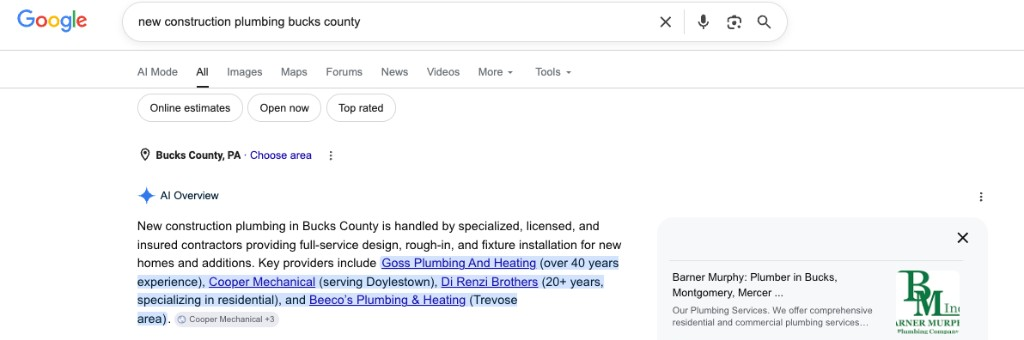
Six months ago, a homeowner running this exact search would never have seen Di Renzi's name. Today, Google is recommending them — by name, in the answer at the top of the page, for the exact service they want to win. That's what a real website foundation buys you.
3. Service pages are getting seen — clicks are the next opportunity
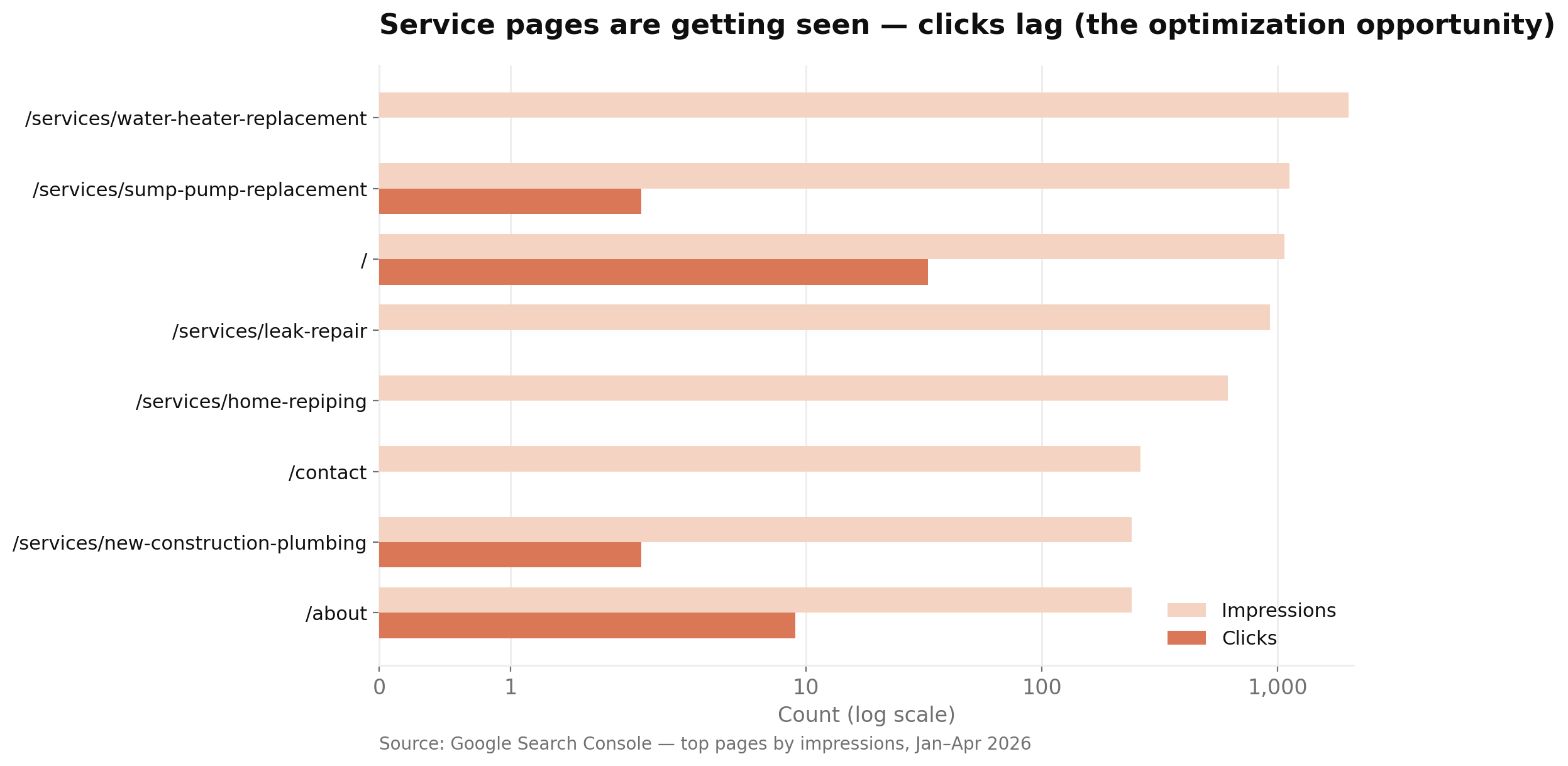
The water heater replacement page got 2,005 impressions but 0 clicks in this window. The leak repair page got 931 impressions and 0 clicks. That looks like a problem — and it is, but it's the right kind of problem to have.
It means the SEO foundation is working: those pages exist, are in Google, and are showing up. The next phase of work — rewriting page titles, adding extra page code that helps Google, and building out more related content — turns those impressions into clicks. We can only do that work after we know which pages are actually showing up. That's exactly what this data tells us.
This is why the framework matters more than the launch. Good websites aren't "set and forget." They're a foundation you build on with real data.
4. On-site engagement: visitors are actually reading
Traffic that bounces is worthless. Here's how visitors from the real service area (PA / NJ / DE) behaved on the site once they got there:
- Avg. session duration (local visitors)
- 1m 40s
- Multi-page sessions
- 37%
- Engaged sessions (>60s or 3+ pages)
- 25.6%
A few things worth pointing out:
- 21 of 86 local sessions stayed at least one minute, and 13 of those stayed past two minutes. Those are research sessions — homeowners reading service pages, comparing options, and deciding whether to reach out.
- The 37% multi-page rate is well above the 20–25% benchmark for local service business websites. People who land here actually click around.
- Top entry pages for local visitors: the homepage (61 entries), the About page (13), and one specific service-area page —
/service-areas/bucks-county/richboro-pa-plumbing— pulled four direct entries from local search. That's the local SEO foundation paying off. - Service-page → conversion path: 12 PA visits viewed at least one
/services/page; 1 of them converted through the form. That's an 8.3% on-page conversion rate for service-page visitors. Small sample, but a strong signal that when the right person hits the right page, the site does its job.
5. Real qualified leads — not just traffic
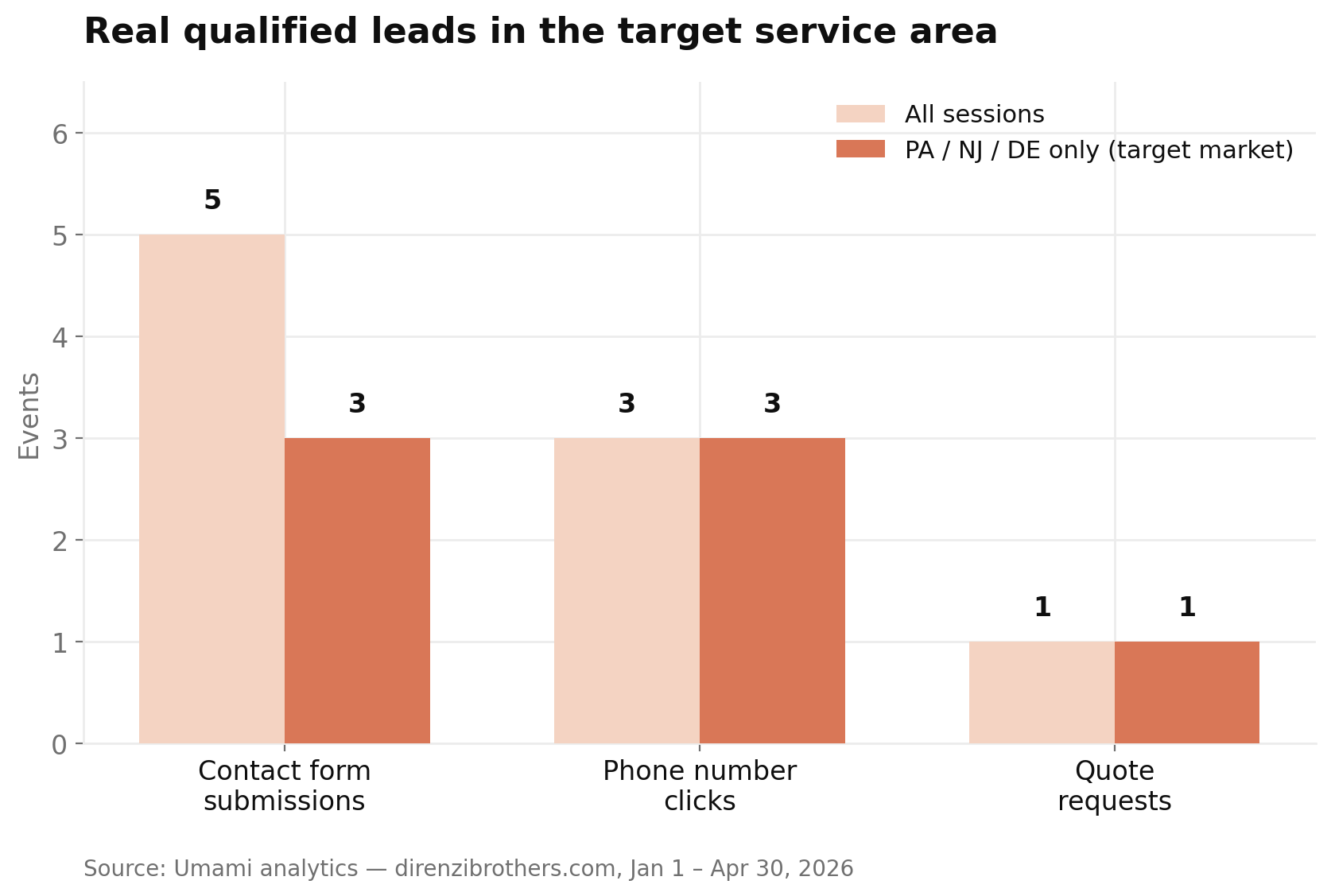
Traffic is interesting. Conversions pay the bills. In the same four-month window, the site fired:
- 5 contact form submissions (3 from PA homeowners)
- 3 phone number clicks (all from one PA mobile session — the exact behavior of a homeowner in active need)
- 1 quote request (PA, mobile, came in through Google)
That includes one new-construction townhome project where Di Renzi was invited to send an estimate — a job they'd never have been in front of otherwise. That's the whole point of a website built this way: it puts you in the conversation.
Why that one quote request matters more than it looks. A new-construction townhome plumbing project — full rough-in across multiple units — typically lands somewhere in the $30,000–$120,000 range depending on unit count and complexity. Even if Di Renzi didn't win this specific bid, the website did the most important thing a website can do: it put them at the table for a job size that referral and word-of-mouth alone would never have delivered.
Run the math on a single closed job of that type:
- Average new-construction plumbing job
- $30,000–$120,000
- Typical net margin on that work
- 20–30%
- Profit on ONE closed job
- $6,000–$36,000+
That's the asymmetric upside of a real online presence. Most leads are smaller jobs — a water heater here, a leak repair there. But a website built around a contractor's actual specialty (in Di Renzi's case, new-construction work) puts them in front of builders and project managers who run searches that referrals will never deliver. One closed new-construction project pays for the entire website foundation many times over — and the foundation keeps producing leads long after that job is done.
This is also where lead quality matters. A website's job isn't to close customers — that's the operator's job. A website's job is to put qualified people in the funnel. This site is doing that.
What This Costs (And What It's Worth)
For a local service business, a website project like this — strategy, full design, service pages, CMS, Google Business Profile setup, analytics, and launch — usually falls in the $3,000–$6,000 range with us. The exact price depends on scope, page count, and how much custom photography or copywriting is needed.
Here's the framing that matters most: a website is an asset. Paid lead generation is rent.
If you spent the same money on third-party lead-gen platforms over the same period, here's what you'd actually be buying:
- Angi / HomeAdvisor
- $50–$100/lead
- Google Local Service Ads (plumbing)
- $75–$150/lead
- Lead exclusivity
- None — same lead is sold to multiple competitors
At those rates, a $5,000 budget on Angi or LSAs gets you somewhere between 33 and 100 shared leads before it's gone. When the budget runs out, the leads stop.
A $5,000 website is a property you own. It brings in leads in month 1, month 12, and month 36. The same money that buys you a few months of paid leads becomes the foundation that earns leads for years — and it builds the branded search momentum we showed above, which third-party platforms will never give you.
This isn't an argument against paid lead-gen. It's an argument for owning the foundation first, then using paid channels to boost what's already working.
What's Next for This Site (The Honest Take)
Most case studies end at "look at the great results." We want to be straight with you about what these numbers actually mean — and what they don't.
What the data is really saying: the foundation works. The site is in Google, showing up for the right searches, and getting real leads in the target service area. That's a successful Phase 1.
What the data is not saying: Di Renzi Brothers is now ranked #1 for "plumber Bucks County." They aren't. The average ranking position across all those queries is around 50, which is page 5 or so. That's normal at the six-month mark for a brand-new site with no link history. It also means most of those "200+ ranking queries" are visible to Google but still buried for most humans.
The current results are the floor, not the ceiling. To go from "showing up at position 50" to "showing up at position 1–10 on the queries that drive real volume," the site needs ongoing work:
- More service-area pages targeting specific towns and neighborhoods
- A steady drip of helpful content (FAQs, project write-ups, blog posts)
- Active Google Business Profile work (weekly posts, photo uploads, asking customers for reviews)
- Backlinks from real local sources (suppliers, partners, BNI, the Chamber of Commerce, local press)
- Rewriting page titles and meta descriptions on the high-impression pages to lift the click rate
Some of this Di Renzi can do in-house. Some of it is the kind of work agencies offer on a monthly retainer. Either path is valid. The path that doesn't work is "launch and forget" — which is what most contractor sites do, and why most contractor sites stay invisible.
If you take one thing from this section: a website is the start of the work, not the end of it. A good build like this one cuts the time it takes to see results, but the curve keeps climbing only if someone keeps building.
Who This Is For (And Who It Isn't)
This case study is written for one kind of reader, so it's worth being direct.
This is for you if:
- You run a local service business (plumbing, HVAC, electrical, painting, remodeling, landscaping, roofing, cleaning, etc.)
- You have no website, a DIY website, or a 10-year-old site nobody has touched
- Your customers find you through referrals, and you want to stop being one bad week away from a slow month
- You answer your phone and follow up on leads
- You can commit to a real discovery process — questionnaire, calls, sending us photos and information
This is not for you if:
- You want a $500 template you can update in a weekend (we have honest recommendations for that path; we're just not the right fit)
- You aren't willing to claim and verify your Google Business Profile
- You expect to rank on page one for "plumber" with no service-area focus and no patience
If that first list sounds like you, keep reading.
Common Objections — Answered With This Data
"I get all my work from referrals. I don't need a website."
You don't need one yet. Referrals dry up when the person referring you moves, retires, or stops being active. Branded search showed up in this case study within six months — which means the next time someone hears Di Renzi's name at a job site, they Google it and land on a real website that converts. Your business is one Google search away from looking either professional or invisible.
"It'll take years to rank on Google."
Within four months, this site went from 0 to 2,300+ monthly impressions on real local searches. It's not on page one for "plumber Bucks County" yet — that takes longer — but it's already in the mix for hundreds of more specific buyer-intent searches. More specific local searches rank faster than most contractors are told.
"Can't I just use Wix / Squarespace / GoDaddy?"
You can. The trade-off is that those tools are built for a fast launch, not for ranking. They'll get you online; they won't get you found. Templated builders bolt SEO controls on as an afterthought — page speed, clean URL structure, schema markup, custom service-area pages, and the ability to spin up new town-specific pages quickly are all harder than they should be.
This site runs on Sanity, a headless CMS paired with a custom front-end. The client gets a simple editor for updating phone numbers, photos, and service pages — and we get full control over the technical SEO knobs that actually move rankings: page speed, structured data, internal linking, and the freedom to add 50 more service-area pages without fighting a template. The framework matters more than the tool, but the tool decides how hard the framework is to execute.
"What if I spend the money and nothing happens?"
That's the right question. Look at the data above and ask yourself two things: (1) does the search-impression chart look like the early days of something growing, or like nothing happening? (2) is your business ready to follow up on the kinds of leads shown in the conversion chart? If yes to both, the math is on your side.
Key Takeaways
Planning beats polish. The discovery and structure phase made the rest possible.
Service pages matter more than the homepage. They're where SEO lives. The homepage is for closing already-warm visitors.
Google Business Profile is the foundation. Most contractors skip the verification, photos, and service-list work. It's free, it's the highest-ROI marketing asset you have, and it's what makes the website's local SEO actually work.
A website is an asset, not a deliverable. It grows month over month. Paid lead-gen stops the day you stop paying.
Lead generation is the website's job. Closing is yours. A site like this puts qualified people in front of you. The relationship work is up to you and your team.
The Honest Next Step
If you've made it this far, you're not browsing for design inspiration. You're trying to decide whether to do this for your own business. The most useful thing we can offer isn't a sales pitch. It's a 20-minute call where we look at your current site (or the lack of one) and tell you, in plain English, what we'd change to start producing the kind of results above.
You'll leave that call with a clear answer either way. Either we're a fit and we send you a proposal, or we're not — and you walk away with a real list of things you can do yourself.
Book a free 20-minute website teardown →
No deck. No long discovery form. Just a real look at where you are and what's possible.